
Copper Peptides: The One Skin Peptide With Real Human Evidence
By Dr. G — Awazul Wellness, Wailea, Maui
Peptides are everywhere in skincare right now, and most of the category is running well ahead of its evidence. A lot of what gets sold as a breakthrough is drawn from injectable or cell-culture research that says very little about what a cream actually does on a human face.
Copper peptides — specifically GHK-Cu — are one of the rare exceptions. They deserve a closer look, both as a topical and, in the right setting, as an injectable.
What GHK-Cu is
GHK-Cu is a small, naturally occurring peptide (glycyl-L-histidyl-L-lysine) bound to a copper ion. It isn’t synthetic. Your body makes it, and it’s part of how skin repairs itself after injury. The problem is that production declines significantly with age — which is exactly why supplementing it has drawn so much research interest.
How it works
GHK-Cu is a signaling molecule, not a building block. Rather than becoming collagen itself, it switches on the genes responsible for collagen and elastin production and helps regulate the balance between the enzymes that build the skin’s support matrix and the enzymes that break it down.
That balance matters more than most people realize. A large share of visible skin aging is simply breakdown outpacing repair. GHK-Cu appears to tip the balance back toward repair — which is also why it has been studied for wound healing and scar remodeling, not just cosmetic aging.
What the human data shows
- Biopsy-based comparison. One study measured skin tissue directly rather than relying on photographs. Collagen production increased in roughly 70% of participants using topical GHK-Cu, compared with about 50% using vitamin C and 40% using retinoic acid.
- Twelve-week facial trials. In women with mild-to-advanced photoaging, cream formulations produced measurable improvements in laxity, clarity, firmness, and wrinkle depth, along with increased skin density on ultrasound.
The body of evidence is smaller than what exists for retinoids or vitamin C. But it is real, topical, and human — which is more than most of the peptide shelf can say.
How to use a topical copper peptide well
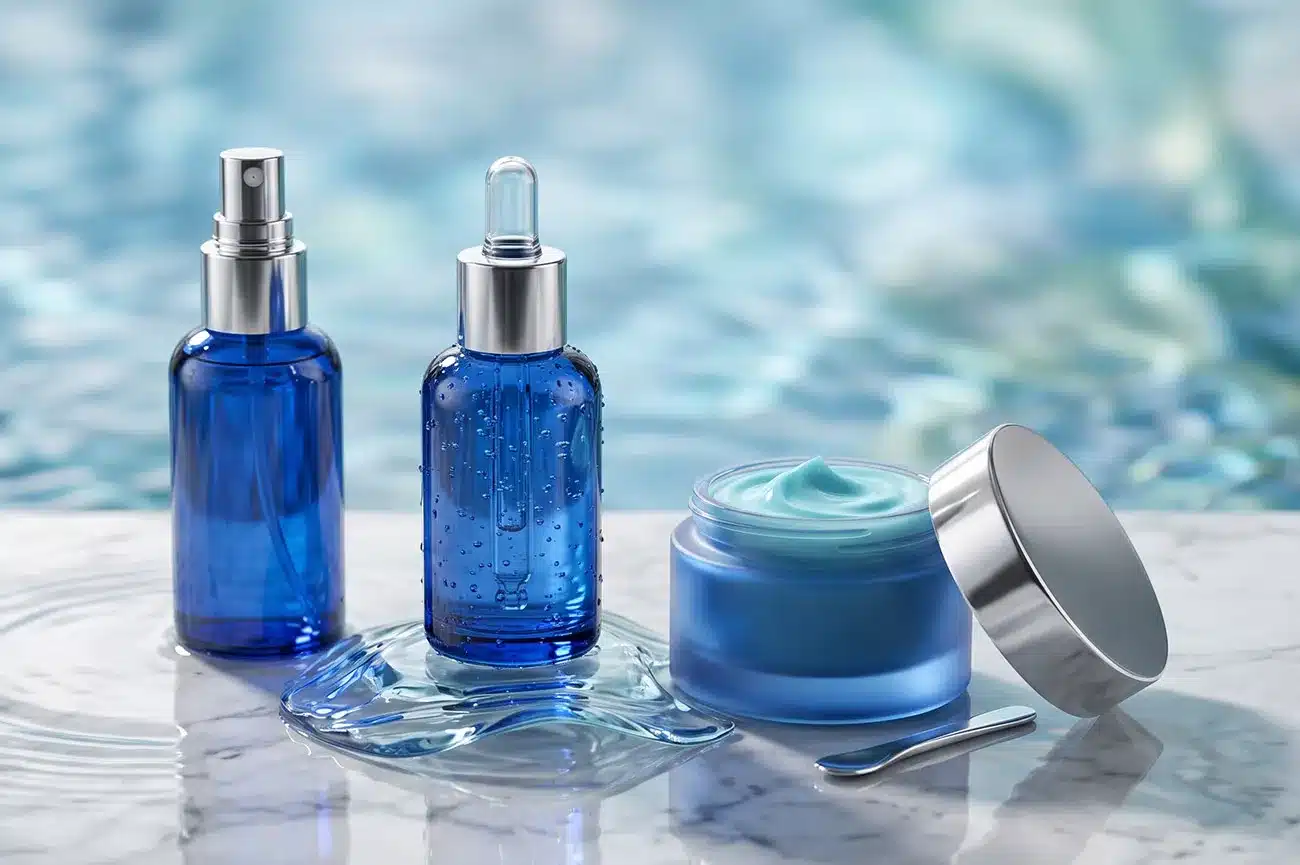
- Formulation matters more than the label. GHK-Cu is unstable and difficult to formulate. It has to survive in the bottle and cross the skin barrier to do anything. A blue or blue-green tint usually signals a meaningful concentration.
- Give it twelve weeks. That is how long the trials ran. Judging it at week two isn’t a fair test.
- Separate it from vitamin C. Copper and ascorbic acid can blunt each other’s effect. Use vitamin C in the morning and copper peptide at night.
Topical vs. injectable GHK-Cu
A serum works where you put it, and only as well as its formulation allows. Injectable GHK-Cu, given as a small subcutaneous injection, delivers the peptide systemically and bypasses the stability and penetration problems that make topicals hit-or-miss.
Injectable GHK-Cu is currently being studied for:
- Skin quality and texture across the face and body
- Collagen and elastin support
- Wound and tissue repair
- Hair and scalp health
It is investigational and not FDA-approved, which is precisely why it belongs in a physician-supervised program rather than an online cart.
Injectable GHK-Cu at Awazul
In our peptide program, GHK-Cu is compounded, dosed, and supervised by Dr. G. Clients learn the injection technique in-office and continue at home, typically over a multi-week course. We often time it around EmFace, PicoSure, or Laser Genesis so the repair signal arrives while the skin is already remodeling, and it pairs naturally with other peptides on our Skin & Aesthetic path.
Every peptide path begins with a Consult with Dr. G or one of our nurses.
Not sure where to start?
Take the Peptide Picker — two minutes, no commitment — and we’ll point you toward the path that fits.
Ready to talk it through? Book a Consult → or call 808.891.2485.
Injectable peptides, including GHK-Cu, are investigational and not FDA-approved. This article is educational only and is not a substitute for individualized medical advice. Physician-supervised. Individual results vary.